Atoms Lesson - Atomic Weight - Atom Mass Number - Science Lessons & Tests - My Schoolhouse - Online Learning
Atoms have charges. There are two kinds of
charges. There are positive (+) charges and negative (-)
charges. Scientists have discovered that some parts of an atom have
positive charges and other parts have negative charges.
PROTONS - have positive charges (+)
ELECTRONS - have negative charges (-)
NEUTRONS - have no charges. They
are neutral.
The number of protons in the
nucleus of an atom determines an element's Atomic Number. An atom
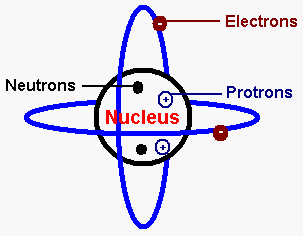
has the same number of protons and electrons. In the diagram below, there are 2 protons and
2 electrons. The Atomic Number of the element below would be 2.
The number of neutrons and
protons of an atom is called the atom's Mass Number.
Each PROTON is given a mass of one.
Each NEUTRON is given a mass of one.
Here's an example:
Name of Element
Number of Protons
Number of Neutrons
Mass
Number
cobalt
27
32
59
Practice finding the atom's
Mass Number for each of the elements listed below. Remember the
atom's Mass Number equals the
sum of the protons and neutrons.
Name of Element
Number of Protons
Number of Neutrons
Mass
Number
zinc
30
35
krypton
36
48
potassium
19
20
silver
47
61
lead
82
125
oxygen
8
8
hydrogen
1
0
calcium
20
20
Directions: Answer the questions
about atoms.
1. A
has a positive charge.
2. An
has a negative charge.
3. A
has no charge.
4. The number of
and protons of an atom is called the atom's Mass Number.